Showing posts with label technology. Show all posts

Saturday, March 1, 2014

A peer review of the first Dubai Science Festival

First heard of as an idea whispered about during a Cafe Sci Dubai session last year, Dubai's first grassroots public science festival snowballed into a months-long endeavor that culminated this weekend in a pan-cultural four-day celebration of science for all. The festival, organized by the people behind Cafe Sci Dubai, included not just presentations and screenings, but dance, music, and poetry too, proving that science is not just a subject, but a culture as well.

(clockwise from top left) Rohan Roberts; Steven Pinker; Raya Bidshahri; Lara Matossian

The opening event, themed "Critical Wonder" was held at the Meydan Theatre, a main sponsor of the event with GEMS Education, and the venue for the remainder of the festival. It consisted of a sequence of short fact-, paradox-, trivia-, prediction-, and motivation-filled talks introducing various scientific/futurist topics, such as the exponential growth of knowledge and technology, astronomy and cosmology, disruptive technologies, and the human brain.

The speakers included festival director Rohan Roberts, lead coordinator Lara Matossian, youth coordinator Raya Bidshahri, and numerous student presenters (if even 10% of the gender ratio survived into professional life, we may not have a STEM gender imbalance in the next generation). My personal favorite talks were those of Bahar Ferdousi on brain malfunctions, and Sasha Nanda on the Hubble space telescope, commendable for their specificity and substance. Recorded shout-outs to the festival from the likes of Steven Pinker and David Deutsch were also played.
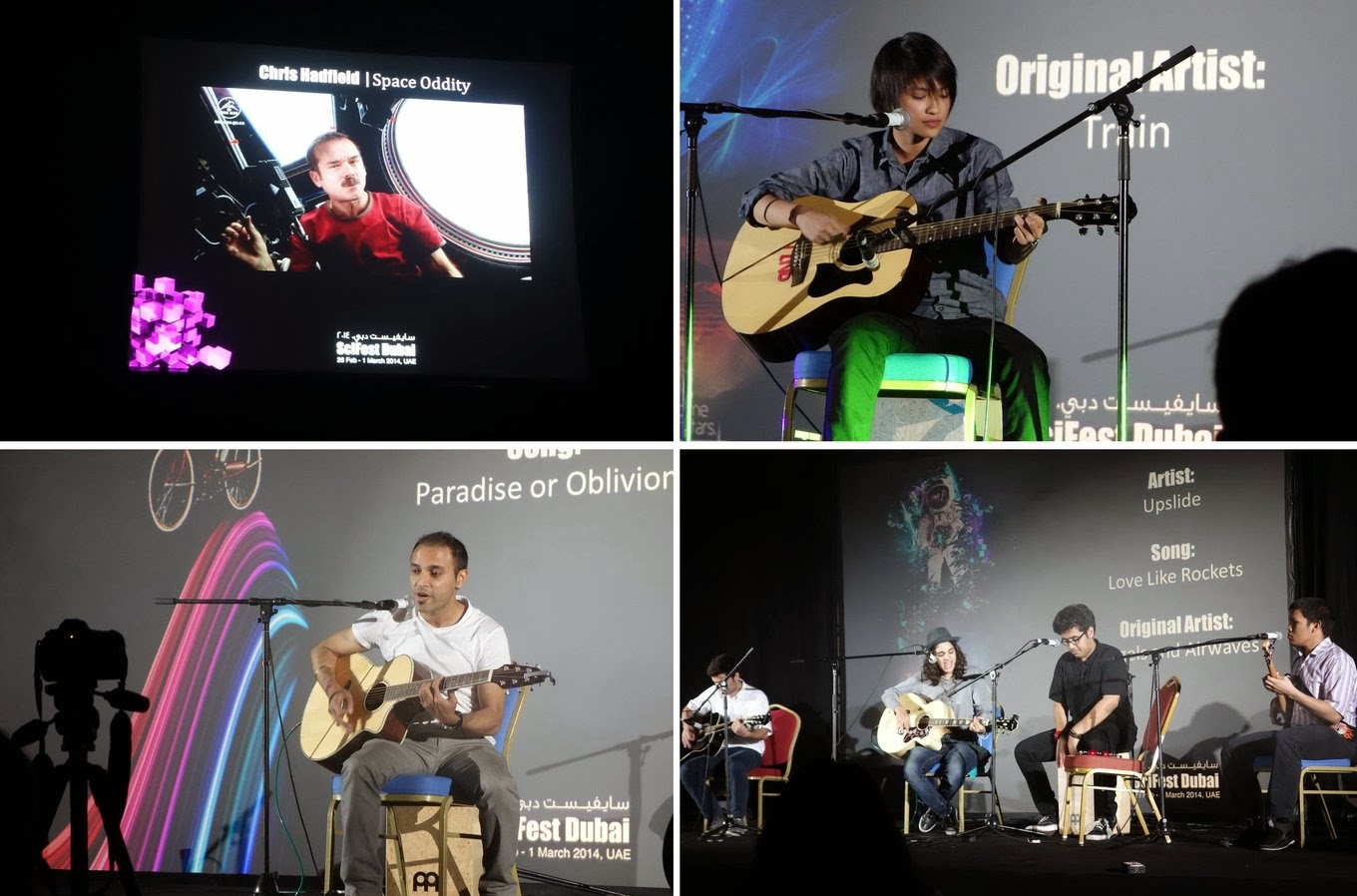

(clockwise from top left) Chris Hadfield; Stacy Locquiao; Monu Singh; Upslide

A night of music followed, made possible by the participation of numerous local acts like When Night Comes, Stacy Locquiao, Monu Singh, Candy Flippers and Upslide, performing songs referencing rocketry, comets, and other sci/tech concepts in a variety of musical genres. Intervals had us entertained with viral science music videos, such as Chris Hadfield's famous orbital rendition of "Space Oddity", Tim Minchin's statistically-correct love song "If I Didn't Have You", A Capella Science's "Bohemian Gravity", and Symphony of Science's auto-tuned opus "The Quantum World".


I had not been to a planetarium since over a decade ago. The inflatable mobile planetarium is not as awe-inspiring as the real deal, but it's a fun experience nonetheless. Besides, the show was about the historical development of astronomy, so it aligned quite nicely with my interests.


Out in the lobbies, relevant companies were promoting their services, students were demonstrating science projects, and a huge gallery was set up to exhibit local and international science-related paintings, graphics and photography. I even spotted a neighborhood attraction: the Moving Image Museum.


I also attended a local science enthusiasts' panel discussion, hosted by 103.8 FM presenter Suzanne Radford, during which science media pioneer Dr Majid al Qassimi, tech entrepreneur Mahmoud Abu Wardeh and science enthusiast Adam Griffin discussed local and global issues in scientific advancement and awareness, together with Rohan and Raya.


One of the surprise highlights of the event was the screening of Hubble 3D. I was only able to attend because of a change in the programme, but was happy to discover that Hubble 3D is a mind-blowing show, especially when viewed in the gigantic IMAX theatre.


The festival then took a cultural turn, starting with models in presumably futuristic makeup strutting a catwalk, professionally choreographed and wearing Imaginary Foundation clothing.


A series of dances from different cultures around the world followed, interspersed with (much to my delight) Dance Your PhD clips.


(clockwise from top left) Ana Rancic; Toby Masson; Taher Kathwala; Jason Silva

"Science is the poetry of reality" is a quote by one "Clinton R D", who joined Aldous Huxley, Tim Minchin, and other authors honored with in-character, prop-aided recitations (performances, rather). Jason Silva's science-passionate odes popped up from time to time too. Toby Masson's character performance of Minchin's viral skeptic classic "Storm" and Jamal Iqbal's performance of his original "When Hadrons Collide" were especially outstanding, in my opinion, as was Taher Kathawala's amazing slam performance of Steve Sanders' "Sky".
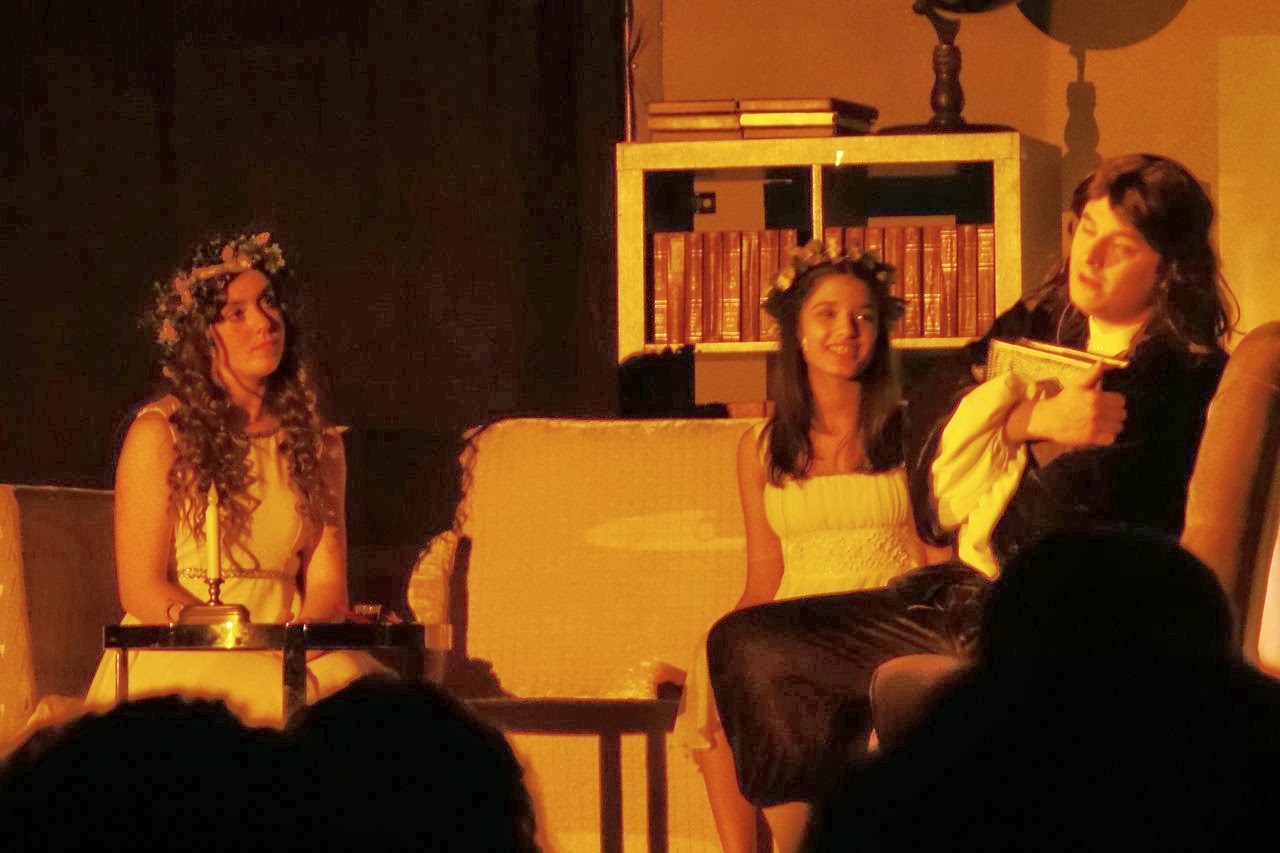


The programme ended with the staging of Lauren Gunderson's Leap, in which Ben Franklin shone as a young Isaac Newton meeting his muses for the first time.


In the closing ceremony, the people who saw the festival through to that moment were honored, including the commendable army of volunteers. I already can't wait for the next one; this festival was executed very well for a first-time experiment, and application of the scientific method will surely result in an even better one next year.

Monday, September 16, 2013

Expo Sciences International 2013 at ADNEC Abu Dhabi

I checked out the 3-day Expo Sciences International student science fair in ADNEC during a free morning in Abu Dhabi. A lot of students had been flown in for this event, some even representing their countries in their national costumes and handing out mini freebies from back home.


The expo had a noticeably large Latin American representation, which was nice to see for the development of that region. It seemed like every other booth was run by Mexicans, and many of them had interesting original ideas or localized applications of existing ideas. Quite a few entrepreneurs as well, and a few others with explicitly entrepreneurial ambitions.


I saw a lot of schoolchildren being bused into the venue in uniform. While that was a good initiative, I would have liked more members of the non-school-going public to visit. Given the 9-to-6 open hours of the expo on three working days, I doubt that would have been possible. Too bad; science is not just for schoolchildren.


Many ideas presented there were very ingenious, and some were a little scary.

Friday, August 30, 2013

Motion and illusion at the Moving Image Museum

TECOM is the kind of place one would associate with business and residential towers, assorted hotels and bars, and an odd, winding, ring road (seriously, it looks like an amoeba eating smaller microbes if viewed using Google Maps). Not "al culthshur", for sure.


Moving Image Museum in TECOM

But culture is exactly what we got earlier this year, when communications magnate Akram Miknas contributed his personal collection of pre-movie motion illusion novelty pieces to create the Moving Image Museum on level 1 of the MCN Hive, the HQ of his MCN company.


Akram Miknas narrating

A short video is first shown to visitors in the film room, narrated by Miknas himself, in which he describes the history of moving image art, and demonstrates with some examples and clips. In the timeline on the entrance wall, one can see that it is dominated by the 1790s to the 1890s, the golden age of the moving image. This is, of course, to be expected; it was the time when global fairs and expositions came into fashion, and attracting attention with crowd-pleasing innovation was the order of the day. To than end, men used all available illusions, materials, techniques and technologies to wow the masses.


Magic lantern

Although the museum looks small, there is a huge assortment of items within. There's an especially nice collection of magic lanterns, ranging from small to huge. These are the days in which projectors had chimneys, instead of vents, as they used combustion to produce light. Whether intricate or rustic, each piece is its own line, being made before modern mass-production injection-molding and standardized parts took off.

Depth illusion peep show and phenakistoscope slides

Other display cases house collections of stereoscopes, mutoscopes, zoetropes, praxinoscopes, and many other devices. There are also a number of these kept out of the display cases, so that visitors can interact with them.

Zoetrope with rotation mechanism, and thaumatropes

The far side of the gallery is dominated by a huge kaiserpanorama, with which multiple visitors can peer at beautiful, high-definition yester-century photography, colored vibrantly, and rotated through 3D steroscopic visors.

Interactive stereoscope and mutoscopes. You can watch the steampunk edition of Avatar 3D.

The gift shop has a nice collection too, priced reasonably. Outside, there's table space for private events. The entry price of AED 50 is about worth the experience; after all, this is the kind of exhibition one typically sees in European capitals. Each item on display is unique, incorporating intricate hand-crafted decorative art work as well as the mechanical and optical trickery necessary to amuse viewers, and and so will invite close inspection. If you're interesting in history and/or science and/or art, you will want to spend a lot of time here; I recommend an hour at least.

Friday, July 12, 2013

Masdar Institute campus expansion opens


The second phase of the Masdar Institute campus has started operating, and my department, Computing and Information Sciences, moved in this past week. For us in CIS, that means no more weird smells and machinery sounds occasionally wafting and blaring in from the chemical labs adjacent to us in the old research building, although those did add to the "sciencey" atmosphere of the place.


The new campus still uses a lot of the old architectural styles; at least, that's way it looks from the outside. Most of the new buildings have the clay-coated wavy and air-padded screened facades of the residential and research buildings in the older part of campus. The new part of campus also seems much, much larger, with multiple courtyards.


The only new building style is represented in a couple of blocks that have facades that slope outwards on all sides. One of these blocks is literally hinged to the top of a set of pillars, which hold it over the swimming pools. Presumably, this design will make their smooth faces less likely to collect dust.


One major concession that has been made is the addition of a rather large car parking lot right in front of the new part of campus. For a few years now, access to the old campus was limited to shuttles, electric vehicles and self-piloting electric pod cars that ferried staff, faculty, students and visitors between the campus proper and the parking lots on the outskirts of the city. Now, private cars will be able to enter the city itself.


Everything is nice and fresh. Our new premises have wide corridors and a lot of meeting/common space, and (seemingly) better cooling.

Thursday, July 11, 2013

Cafe Scientifique returns from the dead

Cafe Scientifique Dubai's latest public science discussion, held the Friday before last at Lila Cafe TECOM , was about de-extinction, and started by dropping an asteroid on pop culture's most cherished vision of someday jeeping around Jurassic Park; at present, we simply cannot get enough intact dinosaur DNA to put together into a workable genetic code.


Rohan Roberts and Raya Bidshahri introducing

But don't lose hope, for we likely can get an Age of Exploration Park up and running, with dodos, sea cows, and other victims of human population expansion put back into the biosphere. Maybe even a Cenozoic Park, full of Ice Age megafauna. And it's perhaps not as exciting for a movie, but we might be able to pull together a garden of recently extinct plants.


Open discussion

There was talk of corporatism, hybridization with extinct lifeforms, extending human rights to Neanderthals, preventing the use of de-extinction as an excuse for further ecological destruction, etc. As would be expected, debates on bringing back dead individuals also erupted every now and then (with broad use of Godwin's Law invoked at one point) until species-level de-extinction was brought back into focus. Basically, the discussions often veered in the direction of bioethics, and while I would have preferred more focus on hows than whys, a fair amount of sci & tech was touched upon collaterally.