Showing posts with label film. Show all posts

Saturday, December 13, 2014

Dubai International Film Festival 2014


DIFF: the week in which I go to a film theater more than during the entire remainder of the year. And attending the biggest cinephiles' carnival in town is not just a way to see films that do not typically make it to theaters here -- it also means bumping into and catching up with many people I've not seen in a while.


I had to be particularly selective this DIFF, though, since my busy schedule that week meant I could take time off only during the weekend evenings. Looking back, I'd say I was generally pleased with my six choices, which encompassed documentary, comedy and drama in equal measure.


(clockwise from top left) Afia Nathaniel on the right, director of Dukhtar; Hind Shoufani on the left, director of Trip Along Exodus; Ali F. Mostafa on the far left, director of From A to B; Gautam Sonti on the left and Usha Rao on the right, directors of Our Metropolis.

Except Haemoo, all of my films had Q&As with filmmakers and/or cast afterwards. I was especially fascinated by the journeys of Ms Nathaniel in making Dukhtar (10 years, in her case), and of Sonti/Rao in making Our Metropolis.

Following are some of my thoughts on the films.

ABOOD KANDAISHAN


Whatever people may think of wasta, this Emirati comedy by Tent Pictures makes its titular character come out likable. The film is set in many locations viewers, Emirati or otherwise, would likely recognize, like Zayed Sports City, and the ADNOC on Sheikh Khalifa Highway, and otherwise avoids glitzy spots in favor of run-down freej alleyways, homely homes, and tranquil terraces. This, in addition to such sequences as the lingering shot of the preparation of the familiar-to-old-timers Oman Chips sandwich, establish Abood as "one of us". The soundtrack was very nice too, and I liked the guerrilla style (well, mostly).

Perhaps this film is about how people don't need wasta, and will be freed from insincere friends/crushes if they are kind and generous. In terms of plot, though, that results in subplot similarity to many "redemption of the good guy" type films, and therefore a good deal of predictability that's not helped much by the obvious Chekhov's treasure chest in the beginning. The deus ex moment that brings the film to a resolution is also jarring in how it does not clearly follow from the plot of film to that point.

I thought the lead actor, Abdulrahman Al Nakhi, was a good fit for the dorkwardly comedic Abood Kandaishan. The supporting cast, however, was mixed among those who did excellent work of it (such as the Indian housekeeper and the Emirati rooftop sage), and some others who seemed to be, well, just going through the motions. The grating perception of the latter was exacerbated by some of the dialogue that might look better on paper than it would in a spoken conversation.

Abood Kandaishan is still trailblazing in Emirati cinema in its genre, and I think this path of portraying the real lives of people who live here through comedy should definitely be explored further.

HAEMOO


South Korea is home to one of my go-to film industries, so I had high expectations. This one had a nicely gritty and realistic style, with good action scenes and dialogue, and good acting talent. The exposition scenes in the beginning were concise, and the tilt was implemented well. Much of the film was shot in nighttime outdoors or low-light indoors, and the scenography for this was done superbly.

Character development was a bit predictable, though, as the established archetypes' traits were simply amplified in response to the escalating horror. A couple of them were outright cartoon characters, and the film was overall very heavy on tropes. Despite these, Haemoo, which was based on a true story, did a good job portraying the perils of human trafficking and the high seas through drama.

DUKHTAR


Excellent actors and world-class cinematography made this film about a dramatized escape from child marriage one of the best I've seen this year. The writing was most commendable; although there were a few cliche bits written to very obviously drive the plot (telling a child to stay put is a good guarantee that they will scoot in a few moments), the filmmakers subverted a few tropes and played a couple of naughty tricks with timelines to spring tactical-level surprises on the viewers. The character development and plot complexity was outstanding too. The natural beauty of the tribal regions of Pakistan is also showcased in all its magnificence, rounding off a very satisfying film.

TRIP ALONG EXODUS


This sorta-documentary presents a rarely-seen face of Palestinian nationalism: erudite, uncompromising, and secular. Its lead filmmaker and interviewer is the daughter of the focal character, the (recently) late Dr Elias Shoufani, and there is as much family album in here as there is political/historical content. This is just something one gets used to as the documentary progresses.

The interviews take place in unassuming, everyday, home surroundings in an apparently very candid, ex tempore manner, filmed unprocessed and crisp, usually with only ambient background sound. There is a lot of editing, as bits from countless reels of archival footage is played in background exposition montages set to electronic ambient music. An additional artistic element is present in overlays of sometimes cute animated drawings that illustrate moments in the interviews.

Other people in his then-present or past lifetime are also interviewed -- interestingly, with no title cards, bringing the focus to the content rather than to the relationships. Dr Shoufani's interviews themselves span several topics, including sometimes scathing analyses of regional political situations and figures. Much editing is therefore also used to splice together soundbites from different interviews into single-topic sequences. These reveal very interesting composite perspectives (some of them even coming across humorous) and together paint a comprehensive picture of a simple yet multi-faceted man -- one who made many hard choices, and of whose life the world should really know more, especially in these times.

OUR METROPOLIS


This documentary follows five years of conflict between human heritage and globalized visions of modernity, depicting the struggles of urban conservationists, entrenched residents, and laborers against metro construction, road widening plans, and stingy government bodies in Bangalore.

Our Metropolis started out uncomfortably kids'-show-like with the "time travel" intro, and is a bit dragged-out in some parts (mainly the protests), but it has overall good editing and shooting techniques, and tells some interesting stories. Especially commendable of the filmmakers was their emphasis on being in the thick of the action, and they mostly let the people and events do the talking live. It's a good documentary, and especially relevant to me, both as a resident of EXPO-bound Dubai and as a likely future frequent visitor to Bangalore.

FROM A TO B


You know it's a road trip film. Which means you have some idea of what's going to happen: misunderstandings, detours, improbable encounters, etc. Even so, Ali F Mostafa's second big feature is one of the best road trip films I've ever seen, as well as the one of the best films I've seen come out of this region, period.

Pay attention to the title sequence, as it includes some exposition details that are later referred to. The trip-bound trio -- a Saudi foil, a straight Syrian, and an Egyptian who straddles the two roles (Fahad Albutairi, Fadi Rifaai, and Shadi Alfons, respectively) -- are all fluently bilingual Arab expats in the UAE, written as novel youth characters in different interesting life stages and situations, and played by fresh but very impressive acting talent.

After the exposition and character establishment sequences are over, and the road trip actually gets underway, the comedic aspect goes through the roof, inducing genuine belly laugh after genuine belly laugh, using well-written and clever jokes that transcend culture and language. Many of bits took me by surprise, and it's not often that this happens. I applaud the writers, as well as the actors for their comedic delivery and timing.

The nice bilingual soundtrack spans a good range of music from classic hits to contemporary, and the cinematography is excellent. The road trip plot also affords opportunities for diverse scenic and interesting locations, of which full advantage was taken. While there were a few morality points, I'm guessing that because the leads were expats traveling through mainly other countries, the film included more bold topics, references, and traits, and was definitely less preachy than City of Life. An excellent supporting and cameo cast -- including some seemingly big names in Arabic celluloid -- ices the cake.

This brilliant comedy, with its themes of friendship and serendipity, is worthy of stocking for repeat watching, and I hope that we'll someday see as bold and as funny a film with a lead Emirati cast and local setting.

Sunday, September 21, 2014

NYUAD Saadiyat Campus and Hamama screening

One of the first events of the NYUAD public programs season was a screening of the Emirati documentary film Hamama. I rarely pass up opportunities to watch a nice local film, so I signed up. Also, it would be a good opportunity to check out NYUAD's new campus on Saadiyat Island, to which its public events have been moved from various locations around Abu Dhabi city, and which also happens to be more conveniently located for me.


The campus is impressive: large, fitted well, decorated subtly and interesting architecturally, with broad paths, big courtyards, and spacious interiors. There is still some work going on in the area surrounding, but the inside seems about completed.


The film was introduced by a faculty member (top left) and screened (right) in a conference center auditorium, followed by Q&A with director/producer Nujoom al Ghanem and writer/researcher Khalid al Budoor (bottom left). While I think the POV shots detracted from the documentary style followed otherwise in the film (I'm sure blindness could have been conveyed in other ways, or established in a single fade shot), and some of the setups looked a little implausible (shayla on head with bare belly?), the film was overall a pleasant watch, with sharp cinematography, some interesting characters, a bit of humor, and good lighting, transitions and sound.

Wednesday, September 10, 2014

The Magazine Shop launches Cult Film Nights

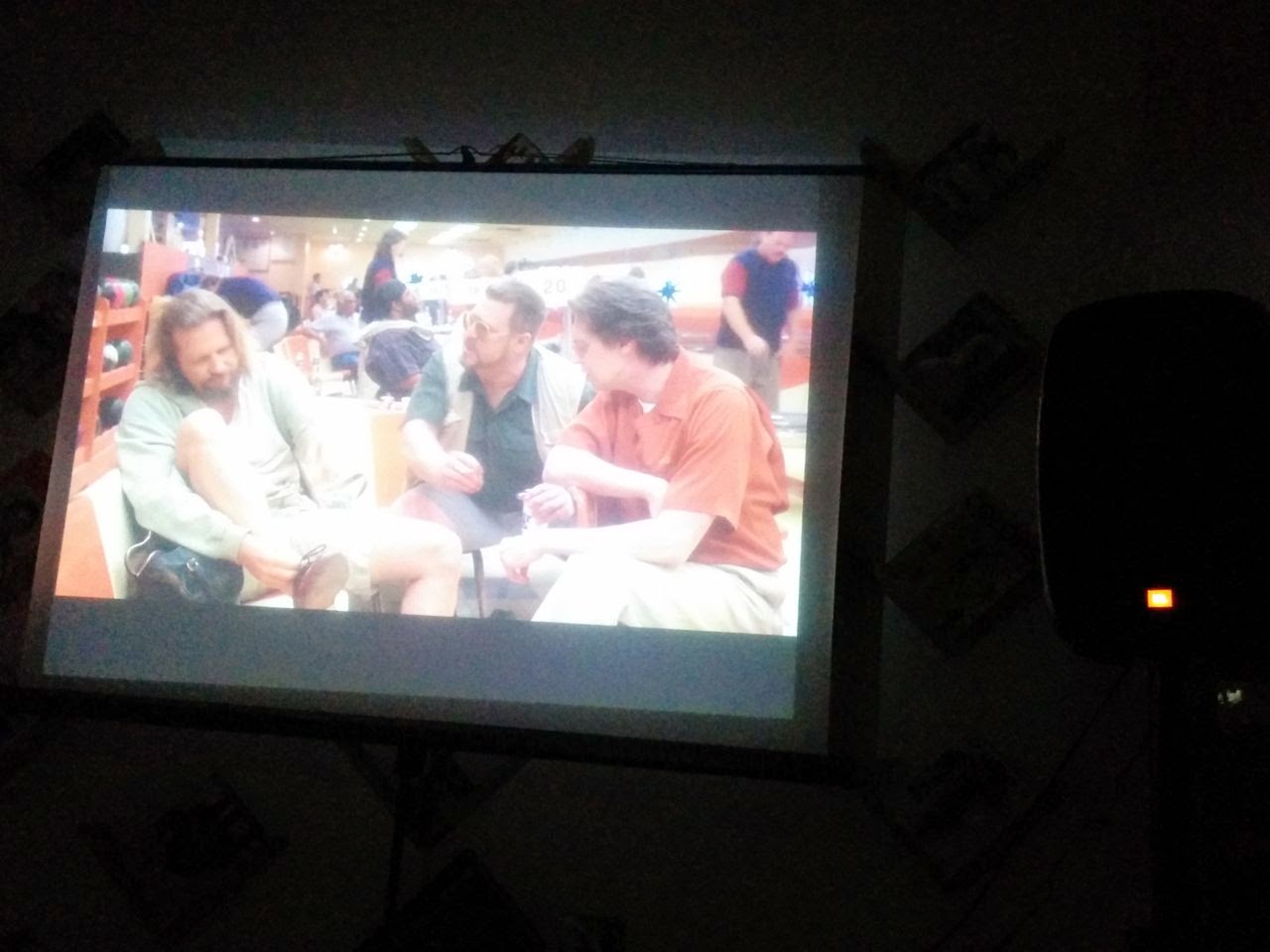
At the screening of The Big Lebowski

Dubai's The Magazine Shop is adding to the diverse array of public film screening options in Dubai with the launch of Cult Movie Nights this season. Cult film standard and internet meme fodder, The Big Lebowski, was selected as the cult film of the month, complemented by the addition of two gourmet popcorn options to the menu of the magazine library cafe's Media City branch. I greatly enjoyed their choice of film, as well as their fresh coffee and their invitation of nominations for next month's cult film screening.

Friday, September 5, 2014

Review of Onmyoji - The Yin Yang Master


I have been interested in the practice of onmyodo and in the stories and legends of Abe no Seimei ever since watching Abenobashi Mahou Shotengai many years ago. My recent wrap-up effort on my Japan travelogue rekindled my interest, leading me to come across the film online. And despite still having a few hallmarks of 90s film techniques, Onmyoji: The Yin Yang Master is redeemed somewhat by its interesting take on Heian Era history and characters, as well as some of its actors.

Apart from Seimei himself, we also get some historical fiction thrown in through the inclusion of the historical characters of Minamoto no Hiromasa and Prince Sawara, as well as a "hidden history" version of why the Heian Era began. Nomura Mansai works well in the role of Seimei, especially with his naughty kitsune face. Ito Hideaki's Hiromasa was played well too, and Sanada Horiyuki did a good job with the role of Douson, even though the character could have been written with more depth.

The demon and magical sequence effects are a little awkward, but the costumes and sets are great, and the cinematography is otherwise up to contemporary standards. I also liked the use of silence and ambient sound in this film. The plot, however, is a tad confusing; the reason for Douson's hatred does not seem very well explained, and there is a lot of hand-waving and just-so employed. Ignore that, though, and it's not a bad film.

Tuesday, August 19, 2014

Earth Girls are Easily Cast

Link: The Problem With The Lady Aliens In 'Guardians Of The Galaxy' (And Most Space Films)

I think many commenters are misunderstanding the article. As far as I can see, it's not against the casting of babe roles in scifi. The complaint is that in a multi-species main cast, the male characters, while certainly including some beefcake, will likely ALSO have a lot of diversity and extremes of phenotype, while any female character(s) are likely to be relatively more heavily anthropomorphized, if not plain human, and fit the one body type.


Photograph: Allstar/Lucasfilm/Sportsphoto Ltd

This has happened with other mixed-species scifi "super teams" too: Star Wars, Farscape, Andromeda, etc. As a general rule, it appears that xenomorphism in the main cast is more likely and more extreme with male characters than with female ones.

I'm guessing that one of the main reasons this happens is that mixed-species main casts in scifi -- because of the shows' intended audience of human males -- tend to be (a) disproportionately male and (b) disproportionately human, with the central characters almost always human or practically indistinguishable from human. If you only have one or two females on your team, and you need to have some potential for a romantic subplot for the human male lead, you can't make make them sexually incompatible from a biological perspective. If FemRocket, FemChewbacca, FemBem and FemPilot were the only females in their respective casts, pairing them with a human character would be imagined as some kind of zoophilia. You might argue for intra-species non-human pairing, but given that multi-species casts also typically have at most one of each non-human species (scifi tokenism), that does not look likely to happen either.

The only solutions I can imagine would be more visibly non-human leads and/or more female main cast members. And maybe junking romantic subplots, but I doubt we will ever see that day.

Saturday, March 1, 2014

A peer review of the first Dubai Science Festival

First heard of as an idea whispered about during a Cafe Sci Dubai session last year, Dubai's first grassroots public science festival snowballed into a months-long endeavor that culminated this weekend in a pan-cultural four-day celebration of science for all. The festival, organized by the people behind Cafe Sci Dubai, included not just presentations and screenings, but dance, music, and poetry too, proving that science is not just a subject, but a culture as well.

(clockwise from top left) Rohan Roberts; Steven Pinker; Raya Bidshahri; Lara Matossian

The opening event, themed "Critical Wonder" was held at the Meydan Theatre, a main sponsor of the event with GEMS Education, and the venue for the remainder of the festival. It consisted of a sequence of short fact-, paradox-, trivia-, prediction-, and motivation-filled talks introducing various scientific/futurist topics, such as the exponential growth of knowledge and technology, astronomy and cosmology, disruptive technologies, and the human brain.

The speakers included festival director Rohan Roberts, lead coordinator Lara Matossian, youth coordinator Raya Bidshahri, and numerous student presenters (if even 10% of the gender ratio survived into professional life, we may not have a STEM gender imbalance in the next generation). My personal favorite talks were those of Bahar Ferdousi on brain malfunctions, and Sasha Nanda on the Hubble space telescope, commendable for their specificity and substance. Recorded shout-outs to the festival from the likes of Steven Pinker and David Deutsch were also played.


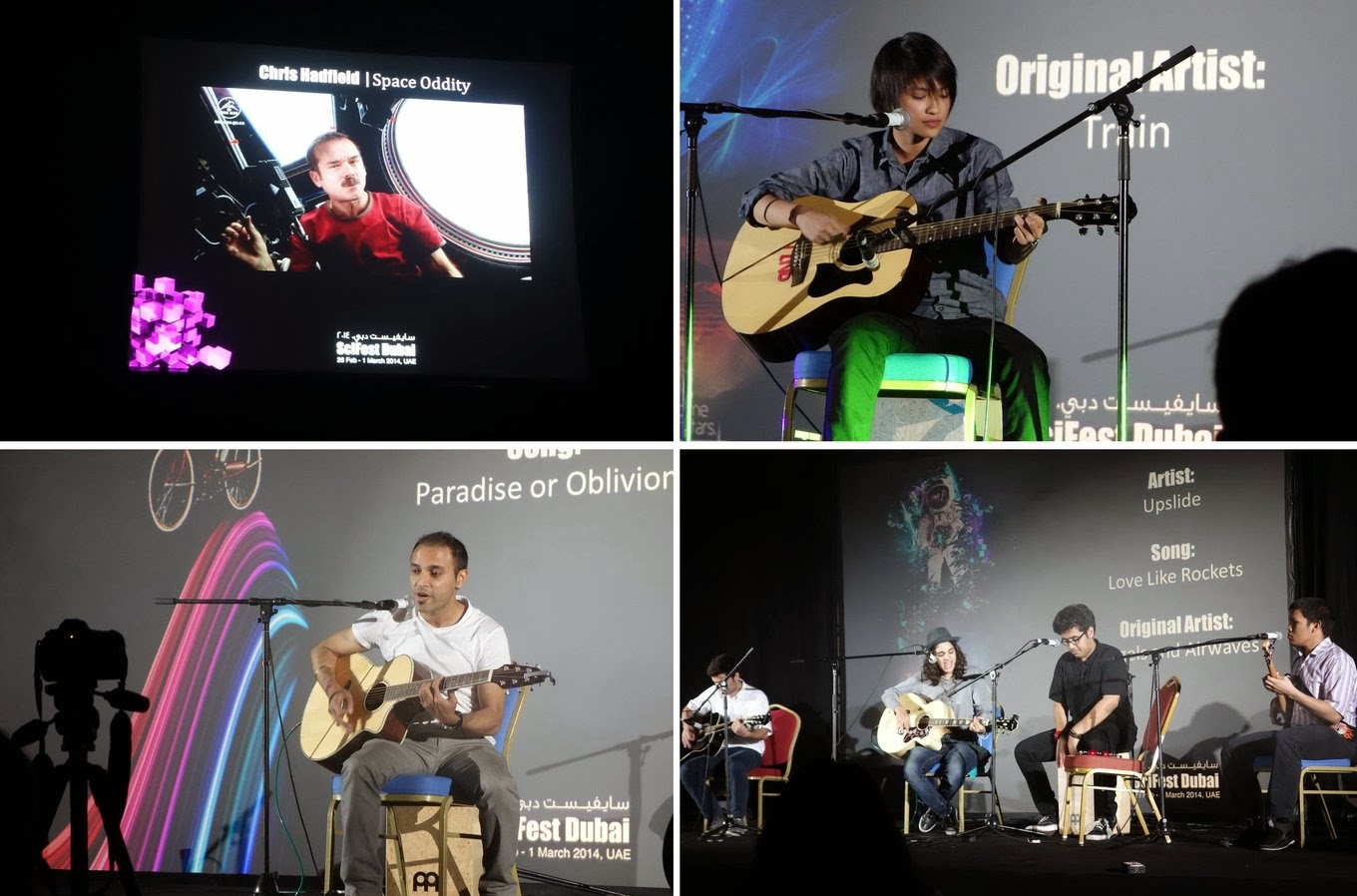
(clockwise from top left) Chris Hadfield; Stacy Locquiao; Monu Singh; Upslide

A night of music followed, made possible by the participation of numerous local acts like When Night Comes, Stacy Locquiao, Monu Singh, Candy Flippers and Upslide, performing songs referencing rocketry, comets, and other sci/tech concepts in a variety of musical genres. Intervals had us entertained with viral science music videos, such as Chris Hadfield's famous orbital rendition of "Space Oddity", Tim Minchin's statistically-correct love song "If I Didn't Have You", A Capella Science's "Bohemian Gravity", and Symphony of Science's auto-tuned opus "The Quantum World".


I had not been to a planetarium since over a decade ago. The inflatable mobile planetarium is not as awe-inspiring as the real deal, but it's a fun experience nonetheless. Besides, the show was about the historical development of astronomy, so it aligned quite nicely with my interests.


Out in the lobbies, relevant companies were promoting their services, students were demonstrating science projects, and a huge gallery was set up to exhibit local and international science-related paintings, graphics and photography. I even spotted a neighborhood attraction: the Moving Image Museum.


I also attended a local science enthusiasts' panel discussion, hosted by 103.8 FM presenter Suzanne Radford, during which science media pioneer Dr Majid al Qassimi, tech entrepreneur Mahmoud Abu Wardeh and science enthusiast Adam Griffin discussed local and global issues in scientific advancement and awareness, together with Rohan and Raya.


One of the surprise highlights of the event was the screening of Hubble 3D. I was only able to attend because of a change in the programme, but was happy to discover that Hubble 3D is a mind-blowing show, especially when viewed in the gigantic IMAX theatre.


The festival then took a cultural turn, starting with models in presumably futuristic makeup strutting a catwalk, professionally choreographed and wearing Imaginary Foundation clothing.


A series of dances from different cultures around the world followed, interspersed with (much to my delight) Dance Your PhD clips.


(clockwise from top left) Ana Rancic; Toby Masson; Taher Kathwala; Jason Silva

"Science is the poetry of reality" is a quote by one "Clinton R D", who joined Aldous Huxley, Tim Minchin, and other authors honored with in-character, prop-aided recitations (performances, rather). Jason Silva's science-passionate odes popped up from time to time too. Toby Masson's character performance of Minchin's viral skeptic classic "Storm" and Jamal Iqbal's performance of his original "When Hadrons Collide" were especially outstanding, in my opinion, as was Taher Kathawala's amazing slam performance of Steve Sanders' "Sky".


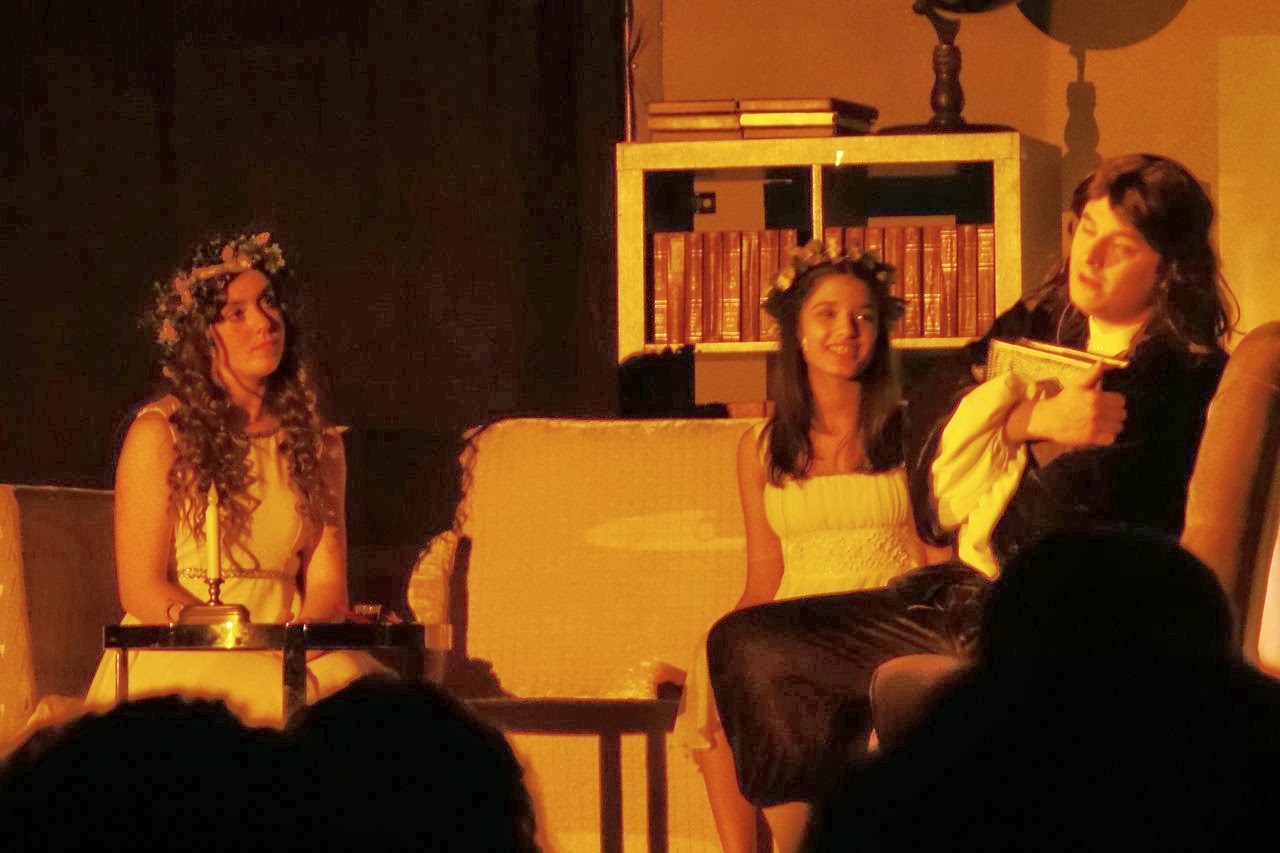
The programme ended with the staging of Lauren Gunderson's Leap, in which Ben Franklin shone as a young Isaac Newton meeting his muses for the first time.


In the closing ceremony, the people who saw the festival through to that moment were honored, including the commendable army of volunteers. I already can't wait for the next one; this festival was executed very well for a first-time experiment, and application of the scientific method will surely result in an even better one next year.

Friday, February 21, 2014

More community film in Dubai

Now that cooler weather is back in town, I thought I'd make the best of it and check out some now-outdoor free film screenings in Dubai. Some are old traditions (well, "old" relative to the Dubai pace), and some have just started out. Here are the ones I enjoyed this past month.


Following the merging of their DIFC gallery into the Bastakiya XVA Art Hotel's gallery space, XVA Gallery's film screenings now take place in the hotel's courtyard cafe. They have had a screening almost every Wednesday, and while the films have ranged from black-and-white classics to 90s cheese, there is seems to be a theme for each month. The hotel itself is lovely, with the rustic ambiance of the converted old merchant quarter along the creek, art pieces installed here and there, and light vegetarian and pescetarian food at the cafe to munch on while watching. One can also check out the gallery's running exhibition at the hotel. Charlie Chaplin films were on in January, so I caught a show of the Chaplin anti-Nazi classic, The Great Dictator, on January 29th.


I also went to the launch event of LOCO'MOTION, a new community cinema initiative, which screened the anti-consumerism/conformism documentary, I'm Fine, Thanks, on February 1st, behind The Archive in Safa Park. They plan to screen films on the first and third Saturdays of every month, and probably ones in similar genres. The grass can be damp, so it would be a good idea to bring a lawn mat.


The Emirates Golf Club Poolside screens a double feature at their outdoor poolside projection area every Friday evening, starting with an animation or children's film, followed by a live action one for grown-ups. The menu's priced at hotel rates, but they do throw in a free tub of popcorn, and you can watch the film(s) while comfortably lounging by the pool on deck chairs, surrounded by palm trees. Here, I watched Open Season on Friday, February 21st.


And if you'd like to unwind and clear your mind with a light B flick, the Pyramids Rooftop Gardens at Wafi hosts a late evening (and free) open-air show every Sunday. I caught a screening of the romcom, When in Rome, on the 26th of January; it was not as bad as its RottenTomatoes.com rating, in my opinion. The audience space is pretty large, with a bar and food service (and, of course, many sit-down restaurants around), a stepped section at the back, and plenty of beanbags. If world cinema is more your thing, they also host an Alliance Francaise French film screening on the first Monday of each month, thanks to which I was able to watch Sport de Filles early in January.

Saturday, January 25, 2014

Alliance Française Dubai launches weekly Cine13 series with Möbius


If the odd theatrical release, screening or film festival do not satisfy your yearning for French cinema, you will be happy to note that French films will be in Dubai as a permanent feature, thanks to the city's Alliance Française. They are launching a series they call "Cine13", in which a fresh French film is rotated weekly at Ibn Battuta Mall's Grand Cineplex, with multiple shows per day to suit as many schedules as possible. I caught a Saturday screening of the first film: the tri-lingual French/English/Russian espionage drama, Möbius.

Tuesday, October 22, 2013

KR&JP 2013 Travelogue Day 12: Castle, costume, craft and cinema in Kyoto

Although logistical concerns with checking out of the hostel and getting out limited my range of mobility on my second day in Kyoto, I managed to get my primary targets in, along with some surprises, and even a couple of "ordinary citizen" activities.


As with yesterday's adventures, I bumped into a couple more unexpected places in this history-packed city. One of them, which I encountered on an early morning walk through a residential area (top left), was the neck-up grave site of Akechi Mitsuhide, identified by a plaque (top right).

Akechi is known for launching a sneak rebellion at Honno-ji that resulted in the death of the first great Sengoku lord, Oda Nobunaga, as well as Oda's eldest son and heir, Nobutada. While his rebellion succeeded in decapitating the Oda clan, retaliatory strikes by Oda's loyal daimyo and their samurai armies ensured that it was short-lived; he was routed, and died while fleeing.

Even so, he had a major impact on Japanese history by ensuring the demise of the Oda clan, and giving two of Oda Nobunaga's subordinates, Toyotomi Hideyoshi and Tokugawa Ieyasu, opportunities to rise in rank and eventually shape the future of the shogunate government. His followers are said to have buried his head at this location, now marked with a "cabinet shrine" (bottom left) containing a simple altar (bottom right).


As the sun broke past the horizon, I headed to my first of two major destinations of the day: the Heian Shrine. This Shinto shrine, like Osaka's Sumiyoshi Shrine and the Fushimi Inari Shrine to the south, is one of the 1st-ranked shrines of Japan. It was also built as scale model of erstwhile imperial residence Heian Palace, which is a good thing from a sightseeing perspective, because there is nothing left of the original palace.

I accessed the shrine through the main (naturally, southern) path, walking the bridge across the Okazaki Canal (top), and passing under the grand torii (bottom). Towering at a height of over 24 metres, it is one of the tallest torii in Japan, and its imposing height, bright vermilion surface and gold embellishments make it look especially resplendent in the morning sun.


The shrine itself is located at the end of the pathway, which is flanked by various art museums, one of which I will visit later. Unlike the shrines I visited previously, and perhaps as a consequence of the aforementioned architectural precedent, it is mostly "whole", with one huge courtyard (bottom), level and clean but for a dragon fountain (top right), encircled by shrine buildings (left top and left centre) painted with liberal splashes of vermilion and most outstandingly roofed with tiles of a beautifully contrasting blue-green color.


And today was an especially good day to be here, because Heian Shrine is the starting point for the Jidai Matsuri, one of Kyoto's annual grand festivals, or matsuri, celebrated with a fabulous parade of everyday people in traditional costumes, marching or riding from here through the city to the Kyoto Imperial Palace.


I did have other plans for the morning, having only found out about this festival the previous night, but the experience was worth clearing out a couple of hours of schedule. It was a visual buffet of history in living color and on living persons. Samurai, priests, attendants, nobles, even early modern era characters -- you name it, they wore it.


After watching the parade depart, I spent the late morning and early afternoon at Nijo Castle. This large, doubly-fortified, Tokugawa-built complex is one of the major destinations of Kyoto. After crossing the outer moat (top right) and entering the main gate (top left), I took a look around the outer grounds and the towers (bottom left), including some reconstruction displays of life here during the age of the samurai (bottom right).


A grand karamon gate (top left), decorated all over with gold, welcomes visitors to the beautiful Ninomaru Palace (top right). Its magnificent rooms' walls are covered with fine gold leaf floor-to-ceiling paintings, and its doorways are decorated with intricate wood carvings (bottom left). An especially interesting feature of this place is the so-called "nightingale" flooring (bottom right), named for the way the floors are built to chirp when walked on by, say, intruders. Encircled by the inner moat is Honmaru Palace, but that palace is only open for special viewings.


Even so, there was plenty to explore, such as the lovely gardens (top left and top right) and ponds (left centre), the inner moat (right centre), and various vantage points from which I could take in great views of the castle buildings and the serene landscape (bottom).


Last but not least in the daylight itinerary was the Kyoto Museum of Traditional Crafts (top), located near the Heian Shrine grand torii. This building featured extensive exhibitions of the traditional cultural arts and crafts of the country, and also had a special showcase of tradition-based design for modern uses (bottom) in one of the lower levels.


As I typically do when I visit other countries, I slotted in some time to eschew tourist sites and experience some citizens' entertainment. To that end, I spent the early evening in BiVi Nijo (top left), a fairly large shopping complex, at the theater (top right) of which I watched the very well-made film, Like Father Like Son (top centre). After that, I went over to the huge gaming area to try my luck trying to win Hatsune Miku figurines (bottom left) and other knick-knacks (bottom centre), as well as playing a really awesome mecha combat simulator in a sealed cockpit controller environment (bottom right).


I spent my last hour before departure in Gion, a neighborhood known for its geisha/maiko patronage and the  architecture. Didn't do much there other than walk around and grab a light dinner, though.


Having woken up super-early, with plenty of time to spare before anything on my agenda opened, I started the day with a leisurely Japanese breakfast (left top) of rice, nori, raw egg, soup and natto. I suppose the sliminess of natto might put off first-timers, as I heard it would, but I did not have a problem, having eaten weirder things on my travels past; frankly, the raw egg was of bigger concern to me. I was also looking forward to trying this dish, as it was highly unlikely to make it to a menu in Dubai. Other than this meal, I stopped by a few cafes between places, including the adorable bear-themed cafe (left bottom) near Ginkaku-ji, and tried some Japanese cinema concessions (right) at BiVi Nijo.


Aside from BiVi Nijo, I did not see much of modern Kyoto, as I had plenty of historical places to visit. I did make an exception, though, for the area around Kyoto Tower (left). But it was a short one, as I had to then make a quick stop at the central station left luggage lockers (automated, of course) before boarding my first Shinkansen train (right top) for a short, comfortable, airplane-like ride (right bottom) to Nagoya.


(top left) Cute cartoon Shell bear.
(top right) Calorie count for taking the stairs.
(bottom left) Multiple pronunciations for the same character (here, '大') -- something kanji shares with hanzi.
(bottom right) You couldn't find an Indian-looking mannequin, so you took a White one and painted him dark brown while leaving the blue eyes and red hair intact. I have no words.


Saturday, September 14, 2013

Movie night at The Cribb


Miranda Davidson Studios screened Training Day at The Cribb in Al Quoz today, which also gave me a chance to check out the venue. The place is located at The Football Centre, which made it convenient to get to from the Manara exit. The Cribb is on the 1st level, and is accessible by swipe card, featuring pay-to-use office space run by i360accelerator, aimed at entrepreneurs and mobile workers. The screening was held in the meeting/event room, en route to which I passed several desks, a modest cafe, and a lounge space.


What I saw of the place looked pretty cool and colorful, and well-designed for its intended purpose. Some in the target market (especially those used to the models of Pavilion Downtown or MAKE) might have issues with them having no on-demand pay-as-you-go options for walk-ins, if not with having to pay at all. For those who can commit to frequent and long-term usage of the place, though, the monthly packages are fairly attractive, and, depending on the package, include such perks as branded workspaces, dedicated desks, and free software access, presently starting at about AED 20 a day (which is not too bad, considering that the cafe is reasonably priced).

Friday, August 16, 2013

Film review of Pacific Rim


A lot of comparisons (and contrasts) have already been drawn between Neon Genesis Evangelion and summer "Gundam vs Godzilla" flick Pacific Rim. I do wonder if this is the closest we will come to seeing an NGE-like film in our lifetimes - the plot and backstory of NGE is far too complex for a popular action film.

The human drama was about as cheesy as would be expected of the genre, with tropes and archetypes galore. There's a convenient plot device of the world-saving war machine needing cooperative piloting by two people, setting the stage for inter-protagonist tension. There's a bumbling scientist duo, people with dead relative trauma and daddy issues, a tough general dude in need of a chill pill, a cocky superstar warrior in need of humbling, etc. There's even what appears to be a tribute to Samuel L Jackson's death in an infamous creature feature.

The rest of it, however, was spectacular. A lot of the film is set in urban coastal East Asia, which is great for battles in colorful cities and beautiful sea locations. It's also closer to home for the Japanese origins of both of the film's constituent genres. I really liked how the mecha - called jaegers in the film - were designed and implemented. These things were so huge they could wade around littoral waters like they were in paddling pools. As were their opponents, the kaiju - extra-dimensional monsters invading Earth. Each kaiju and jaeger had distinctive looks and unique characteristics (which I'm sure will be great for toy lines), from extra arms and specialized weapons to claw tails and bio-EMP.

Guillermo del Toro was a good choice for this film, as he is great with choosing the right imagery - a sort of Mexican Tarsem Singh. The battles take place at night, so the urban glow, jaeger feature lighting and kaiju bio-luminescence really come through for a great overall look. Both jaeger and kaiju tower over most buildings, inspiring awe in the viewer, and their mechanical and biological aspects of each were well-executed. The battles featured little use of ranged weapons, except as finishing moves; they would rapidly descend into what can basically be described as massively super-scaled epic bar brawls (justifying the jaegers' otherwise-unnecessary humanoid forms), complete with the opponents wrestling, butting, pummeling, and using available objects to bludgeon and hack at one another. Which is simply glorious.


Tuesday, August 6, 2013

Film review of When I Saw You


When I Saw You, a 1.5 hour film by Palestinian independent filmmaker Annemarie Jacir, has been running several times a day throughout Ramadan in Abu Dhabi's Marina VOX theatres. The film is set in what looks to be the sixties or seventies, as Palestinian refugees continue to pour into camps in the surrounding Arab countries, and focuses on the story of a boy named Tarek, living in one of the camps.

Tarek, feeling suffocated by his mother, runs away from the camp to look for his missing father, soon finding his unique observational skills useful in a nearby multiracial coed camp of fedayeen led by an openly Maoist commanderMilitary strikes by both sides in the conflict take place off-screen only, so it's more of a barracks drama. The fedayeen camp is located in a forest, making for a good visual backdrop, and the film has a good cinematic quality. The couple of fireside acoustic songs do well for the soundtrack too. A single scene set beyond either of these locations, in which Tarek encounters prejudice and pity from some locals, introduces some more context about the refugee experience.

The tension between the independence-seeking son and the protective, weary mother drives the plot, while crises, friendships and power struggles in both camps provide dramatic punctuation now and then. I found Tarek's stubbornness to be quite annoying at times, but his pluck and talent made him endearing at others. An apolitical character, he is primarily driven by the search for "home", even after finding camaraderie and respect among the fedayeen. The film also has a number of humorous/cute moments, and an interesting surprise ending.

Wednesday, July 17, 2013

Film review of I Am Kalam

Harsh Mayar in a film poster

I rented Indian independent film I Am Kalam this week. Set in Rajasthan, it is the story of a talented and driven boy who seems destined for a childhood spent busing tables at a roadside tea house. Already a voracious reader and a keen learner, a brief about the rags-to-riches story of Indian president A.P.J. Abdul Kalam on TV inspires him to rise above his disheartening circumstances. 

There's some good film-making by director Nila Madhab Panda evident in the film, despite it being an indie on a relatively low budget. The cinematography does justice to the vibrant colors and scenery in the film. As with many indie Indian films, there are no implausible song & dance routines to interrupt the story with unnecessary camp. Apart from a little awkward acting by some of the foreign cast that were roped in for bit parts, and a couple of moments that were predictable on a tactical level, it was a good show on the acting and writing fronts.

Lead actor Harsh Mayar deserves every award he has received for his part in the film; his expressiveness and delivery really generates the bulk of its charm. The film also received a lot of awards, and with an appeal for all ages, ought to have done better at the box office.

Thursday, July 11, 2013

Entre les Murs at The Scene Club


The Scene Club's monthly screening of independent film continued in July with Entre les Murs (literally, "between the walls", but titled in English as The Class). It's not hard to see why it has been reviewed so glowingly. For one thing, high school is subject matter to which almost anyone can relate. Furthermore, the way this particular subject matter is handled is very mature. That is, it is not your typical high school film, focusing on clique and cliche. Nor is it preachy on some socio-economic issue.

Rather in line with its documentary-style cinematography, it is a depiction of fairly ordinary term for a fairly ordinary bunch of students taught by fairly ordinary faculty of schoolteachers, mostly following the daily life drama in one class on the French language. The genius is in keeping the occurrences and dialogue very believable, and carrying it through with extremely good acting down to the smallest role. This makes the two and something hours of running time enjoyable - almost surprisingly, given the barest hint of a plot. Highly recommended.

Saturday, June 15, 2013

Scene Club film "Sta Per Piovere" at Knowledge Village


The Scene Club's latest film feature, It's About to Rain, is set in Florence, Italy, depicting an immigrant father and his Italian-born sons fighting against deportation to their native Algeria. The father has lost touch with Algerian culture, and his sons never had it in the first place.

It's an overall good movie. I liked the raw setting in the average home and street, rather than high culture and landmarks; the director confirmed during Q&A that this was a deliberate decision to make it possible for any Italian to relate to it. There was some really good choices with lighting evident in it as well. The only drawbacks were it pontificating a bit when the characters went over the legal issues, and what I think was overuse of montages.


The Q&A with Italian-born half-Italian half-Iraqi director Haider Rashid brought up some interesting points on the casting, writing and reception of the film. As expected, it attracted some ire from Italian right-wingers. Rashid also suggested that the treatment of Italian immigrants to other countries in centuries past should invoke empathy for modern-day immigrants to Italy. Naturally, the issue of expats living almost all their lives in the UAE (born and raised, in many cases) was brought up a couple of times. Rashid tactfully stayed away from opining on what would be the right thing to do, hoping instead to open the topic for discussion.

Tuesday, June 4, 2013

DIFF film "The Stranger" at Pavilion Downtown


I always look forward to DIFF's Film Buzz series at Pavilion Downtown. One of last month's select trio was an Orson Welles classic The Stranger. The cinematography is outstanding (with the characteristic close-ups for effect), and while featuring a few predictable moments, the plot pacing and development was generally good as well. It's a great showcase for Welles' abilities as an actor and director.