Showing posts with label christmas. Show all posts

Saturday, January 3, 2015

Yule love Scandinavian baking

Christmas baking time again, and it's a return to Europe with a tea party of Scandinavian Xmas treats. Rather than do a pan-Scandinavian, I decided to do one of the most essential Xmas bake from each of the three Scandinavian countries: Denmark, Norway, and Sweden.


Beginning in Denmark, I started with pebernødder (pepper nuts, literally). There's no pepper in them, but there's a hint of a spice or two, depending on the recipe. For mine, I used a teaspoon of ground cardamom, mixing it with 350g flour and a half teaspoon each of baking soda and baking powder. I then mixed 225g sugar with 80g salted butter, folding in an egg and then 100ml whipping cream. I combined this with the flour mixture to get a dough, kneading and adding a little flour until homogeneous and firm.


I pulled fist-sized blobs from this dough and rolled them out into long sausages on a floured board, using a greased knife to cut out inch-long segments to lay out on the baking tray for a 15 minute bake at 225C, until they got golden brown on top.


I got 48 pebernødder from this recipe. These were mildly sweet and subtly spiced, delicious eaten with hot tea, and kept well after as leftovers.


Moving on to Norway's sandkaker (sand cake). I mixed 200g butter into 250g flour to get a dense dough, adding in 100g almond flour, an egg, and 100g sugar to knead. The almond flour gives it a sandy texture to which the name refers. I refrigerated the kneaded combined dough for about an hour, covered.


I had bought special shell-shaped tartlet tins for this item; it is the traditional shape, although I could have used my regular flat tartlet baking tray had I not been able to find them. While preheating the oven to 175C, I pressed the cold dough into the tins (perhaps a little too thickly, in retrospect), and then baked them for about 15 minutes, until the edges of the tartlets became golden brown. After they were done baking, I let them cool for about 10 minutes before prying them out of the shell tins and letting them cool to room temperature. 24 sandkaker in all, and maybe half as many more if I had spread them thinner.


Lacking multe berries, I made do with raspberries to top, spread over with generous helpings of whipped cream to make a treat that appealed to the palate and eye alike.


The final baking destination was Sweden and its saffransbullar (saffron bun), also called lussekatt (after St Lucy's Day, which falls during Advent). In a mortar, I ground up 1.5g saffron with about a teaspoon of sugar, and cultured 25g yeast by mixing with 150ml warm milk and 100g warm melted butter, letting it sit for several minutes. I then added the ground saffron and 100g sugar, plus half an egg, half a teaspoon of salt.


Finally, I added 375g flour, kneading up a dough into which I mixed about 40g raisins. I let this springy dough rise, covered, for about 30 minutes in a warm place. I rolled lumps of twelfths of the dough out into small sausages, letting them sit covered for 10. Finally, I rolled them out twice as long, then rolling in the ends into double-spiral S-shapes around a couple of raisins, and letting them sit covered for about 90 minutes. Before baking for about 5 minutes each at 220C, until golden brown on top, I brushed the buns with a mixture of the other half of the egg and a couple tablespoons of water.


The buns were delightfully fluffy, sweet to the taste, and a gorgeous bright yellow color inside and out.

Saturday, December 21, 2013

Cooking Filipino for a Pinoy Pasko feast


The long-awaited publication of my thesis offshoot research came to be this year, with Dsouza, S., Gal, Y., Pasquier, P., Abdallah, S., and Rahwan, I. (2013), "Reasoning about goal revelation in human negotiation", IEEE Intelligent Systems, vol. 28, no. 2, pp. 74-80, March-April, 2013 finally making it to press. As first author, I felt obliged to be the host for the celebratory get-together. By the time we all got our hard copies and the case was finally closed, it was close to year-end, and I thought "Why not make it a Christmas lunch?".


Decked my hall with color-coordinated decorations, as usual, and my "Christmas bamboo".


As for the choice of the cuisine, I have long nursed the ambition to prepare a traditional Filipino Christmas sweet as part of my Christmas cooking experiments. Seeing as I was going to host a meal, I decided to make it the dessert, and just make the whole meal Filipino. To set the mood, I tuned the radio to local Filipino radio station TAG 91.1, and poured some Filipino coconut water as a welcome drink for my party of 5.


My menu was to consist of dishes that were as uniquely Filipino as possible -- no kaldereta or pancit here. I chose to start with a special Filipino dish: sinigang, a tamarind-flavored soup. I started by dropping 5 small quartered tomatoes and two medium chopped red onions into a pot, adding 8 cups of water to boil.


I then added and simmered boneless pieces of two medium milkfish (bangus, a Filipino favorite) for 10 minutes, followed by 8 large pinches of tamarind pulp for another 5.


Finally, I added about 200g cut string beans (sitaw), a large bundle of cut spinach (could not find kangkong) and four whole long green peppers (siling haba).


Served hot and seasoned with Filipino fish sauce (patis), this was delicious and appetizing, and went very well with shrimp crackers. A great start to the meal, and extremely simple to make.


Another uniquely Filipino dish is pinakbet, a vegetable stew from the northern part of the country. You can actually get the ingredient veggies for this neatly cut and packed at Filipino-oriented supermarkets. It's just a bittermelon (karela, to Indians), two Japanese eggplants, a couple of cups of okra, a small squash, a bunch of sitaw, and a tomato --- all cut into broad chunks -- with a finely chopped red onion. I topped all this in a pot with 4 tbsp sauteed shrimp paste (bagoong), and cooked them with a cup of water for about 20 minutes, until the vegetables were tender.


Adding 400g shrimp and a little more shrimp paste in the last few minutes of cooking rounded things off to make a colorful and tasty dish.


A Filipino feast specialty is kare kare, a peanut-based stew of oxtail with vegetables. For this, I put 750g oxtail pieces in a pot with three quartered small red onions, three finely chopped cloves of garlic, and a teaspoon each of salt and pepper, with enough water to cover everything. I simmered this for about 3 hours, skimming fat and foam off the top, until the oxtail was tender.


I then stirred in chunks of a large eggplant, two small heads of bok choy, and a large bunch of sitaw, for about 20 minutes of further simmering, before adding 6 tbsp of creamy peanut butter (stirred into the broth in a separate bowl first).


It's a bit fatty, but the oxtail meat is extremely tender and tasty, and the peanut broth goes well with white rice.


And what Filipino feast would be complete without adobo, the "unofficial national dish" of the Philippines? A simple dish as it was, I made it by mixing 265 ml soy sauce, 265 ml water, 135 ml vinegar, 40 ml honey, 2 tbsp minced garlic, 4 bay leaves and 1 tsp black pepper, and simmering a kilo of chicken pieces in this for about 45 minutes.

I then drained and grilled the chicken while I discarded the bay leaves and simmered the remaining liquid down to about a cup, pouring it over the grilled chicken to serve. Second helpings were requested at the dinnertable, so I guess it can't have been too bad.
   

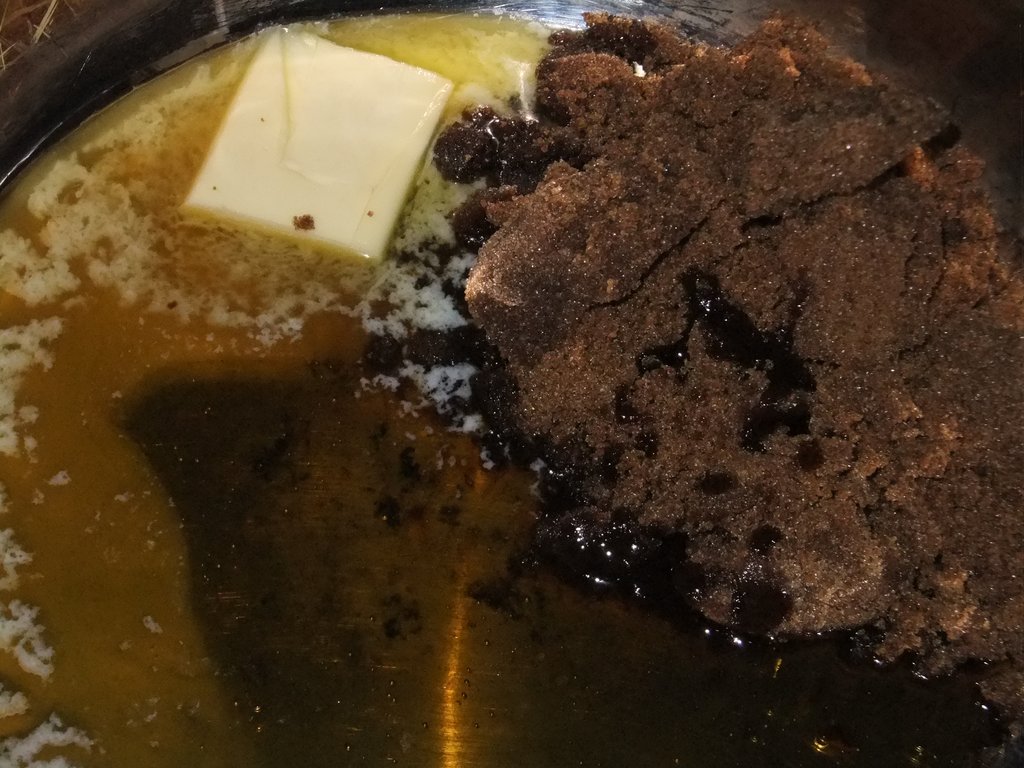
Finally, the reason for the meal of the season: bibingka, the quintessential Filipino Christmas cake. I stirred a cup of brown sugar into 50g of melted butter to start.


I mixed 2 cups of rice flour, a tablespoon of baking powder and a half teaspoon of salt into the butter and sugar, and stirred in 400ml of dessert-type coconut milk with 6 tbsp of fresh milk to make a toffee-colored batter.


I baked this at 190C for about 35 minutes (if I could find banana leaves, I would have lined the pan with those), taking it out midway to top with grated edam cheese (another Filipino Christmas thing).


Cooled, brushed with butter, and topped with more brown sugar and fresh grated coconut, it was much appreciated by guests, served to them as it was with the Filipino traditional Christmas ginger tea salabat (2 inches pounded fresh ginger and 2 tbsp brown sugar, boiled into 4 cups of water).

I hope this inspires some of you to try making some of these. All the best, and Maligayang Pasko (Merry Christmas)!

Monday, January 21, 2013

Lebkuchen und Stollen: A German Christmas

The Germans have a great tradition of Christmas treats, so I chose theirs as the theme of the season. I wanted to make Stollen again, and since I wanted to make a gingerbread, I decided to supplement it with German ginger cookies called Lebkuchen.


First, honey, dark sugar and butter are melted in a pot (which will also be used to make the batter).


Next, flour and baking powder are mixed with powdered ginger, nutmeg and cinnamon.


The dry ingredients are stirred into the melted ingredients with ground almond until a thick, tough batter results.


The batter is chilled overnight until it's firm and malleable. It can then be rolled out and cut into shapes, but I used my trusty tart pan to shape them while they baked at 180C, turning them over and flattening them out with a spoon about two-thirds of the way into the baking.


Once baked and fully cooled, they can be glazed with a simple glaze of confectioner's sugar mixed with a little water. The lebkuchen can be served cold, and if baked dry enough, will keep for a long time.


For the stollen, chopped candied fruit and raisins are drizzled with vanilla and almond extracts, sprinkled with grated lemon peel, and mixed in with ricotta cheese, egg and egg yolk, and toasted almonds.


Flour, sugar, baking powder and a pinch of salt are mixed with butter until a crumbly texture results.


The dry ingredients are mixed in with the wet ones and the resulting dough is kneaded and molded into a loaf on a floured baking pan.


Baked at about 180C, it will rise a little, and brown a crust.


The stollen loaf can then have confectioner's sugar sifted over it for a traditional look.


Thursday, December 23, 2010

Wednesday, December 15, 2010

O Christmas ... Bamboo?!

Well, I already have a couple of bamboos around the living room, I don't have room for a large tree, and I don't want a miniature. So, here's to applying a little Christmas creativity.